


Industrial briquetting machines and grinders for every need.
What are industrial briquetting machines?
Briquetting machines are hydraulic machines designed to recycle and compact chips, dust, and industrial processing waste into high-density cylindrical briquettes.
Unlike traditional disposal—which is expensive, bulky, and impactful—a briquetting machine converts the waste management problem into an opportunity: savings in transport and disposal costs, recovered workshop space, and, for many materials, a sellable product or one that can be reused as fuel.
Integrating a briquetting machine into the production cycle means taking a concrete step toward the circular economy, adding value to waste chips by transforming them into high-density briquettes and thus secondary raw materials. This significantly reduces environmental impact while generating economic value.
What are industrial grinders?
The Dinamic Series Grinders are single-shaft machines with a hydraulically operated pusher drawer, designed to grind wood scraps from carpentry shops, pallets (without nails), MDF panels, paper, and corrugated cardboard from industrial sources, reducing their volume to a uniform particle size ready for briquetting.
The ground waste can be aspirated into pneumatic collection systems and sent directly to the briquetting machine, or deposited in containers for subsequent processing.
Integrating a grinder into your plant’s production cycle means taking another concrete step toward the circular economy, fully utilizing processing waste that, due to its size and shape, would otherwise be incompatible with the compaction cycle. Raw waste is ground into fine particles, which are then turned into fuel briquettes, raw materials, or products for resale.
Key Strengths
01
Excellent versatility in handling different types of materials
02
Construction superiority, great reliability, and uncompromising performance.
03
Cutting-edge technology, top-quality components, and an excellent quality/price ratio.
04
No complex structural modifications and immediate integration.
05
Maximum installation flexibility, quick startup, and ease of use and maintenance.
06
Design, compactness, and ergonomics.
07
Low operating costs, reduced maintenance interventions, and a long service life.
08
Designed to meet your expectations.
09
More than 130 specific checks during the testing phase to ensure excellent quality.
Which series is right for you? Compare COMAFER solutions.
COMAFER offers two lines of industrial briquetting machines, each optimized for specific types of materials and company sizes. The choice of series depends primarily on the type of waste you produce.
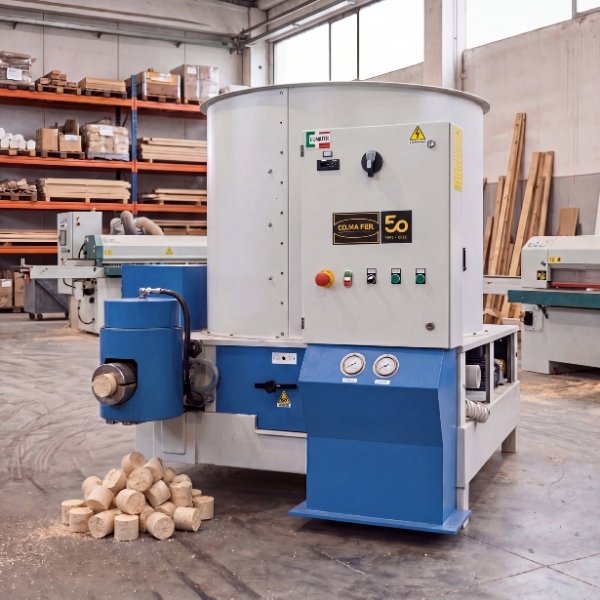
Dinamic Series Briquetting Machine
They are hydraulic machines designed to recycle and compact wood chips and dust, paper, biomass, plastic, and other industrial processing materials into high-density, high-value cylindrical briquettes with significant advantages.

Dinamic Series Grinder
These are hydraulically driven single-shaft machines designed to grind wood and MDF scraps from carpentry shops, as well as pallets, paper, and cardboard from industrial facilities, into a uniform particle size ready for briquetting, offering significant advantages.
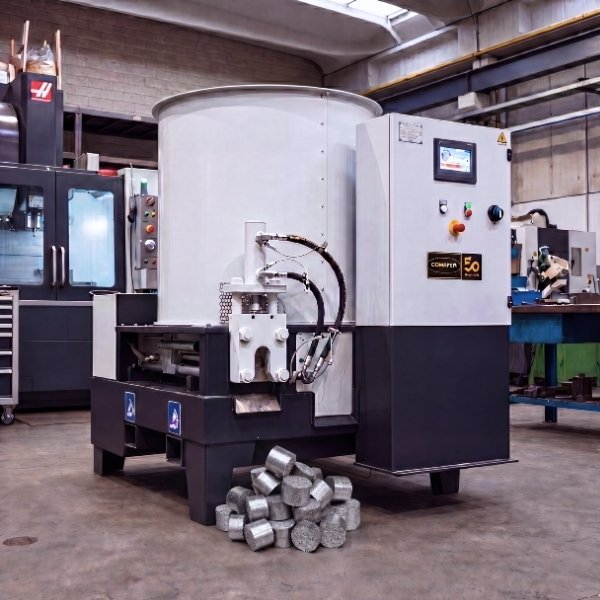
Metalpress Series Briquetting Machine
These are hydraulic machines designed to recycle and compact aluminum, steel, titanium, cast iron, copper, and other metal shavings from machining operations into high-density, high-value cylindrical briquettes, offering significant advantages.
Why turn wood chips, sawdust, and ground industrial waste into briquettes?
Every year, companies lose significant resources in the management of metal shavings, dust, and production waste.
COMAFER briquette presses and grinders transform this cost into tangible value, which can be measured across six key areas:

Volume
Compacted wood chips, sawdust, and ground waste take up up to 90% less space, making work areas much more organized and efficient while significantly reducing the need for labor.

Recycling Costs
Briquettes, which are destined for collection centers and foundries, have a market value that is up to 50% higher. Waste materials—such as wood—optimize briquette production, with all the resulting benefits.

Handling Costs
The forklift replaces manual operators. Briquette handling is fast, safe, and standardized, drastically reducing operating times and risks.

Combustion Yield
Briquettes made from wood chips and ground wood scraps have a heat value of 4,000–4,500 kcal/kg, compared to 2,000–2,300 kcal/kg for firewood. Less fuel, more heat, and less boiler maintenance.

Coolant Recovery
Specific to the Metalpress Series: during the pressing of metal chips, up to 90% of the coolant is recovered, providing an immediate economic return.

Measurable Sustainability
Fewer containers, fewer trips, fewer emissions. Briquettes are part of the circular economy and improve the company’s ESG profile, increasingly relevant for customers and investors.
Volume
Compacted wood chips, sawdust, and ground waste take up up to 90% less space, making work areas much more organized and efficient while significantly reducing the need for labor.
Recycling Costs
Briquettes, which are destined for collection centers and foundries, have a market value that is up to 50% higher. Waste materials—such as wood—optimize briquette production, with all the resulting benefits.
Handling Costs
The forklift replaces manual operators. Briquette handling is fast, safe, and standardized, drastically reducing operating times and risks.
Combustion Yield
Briquettes made from wood chips and ground wood scraps have a heat value of 4,000–4,500 kcal/kg, compared to 2,000–2,300 kcal/kg for firewood. Less fuel, more heat, and less boiler maintenance.
Coolant Recovery
Specific to the Metalpress Series: during the pressing of metal chips, up to 90% of the coolant is recovered, providing an immediate economic return.
Measurable Sustainability
Fewer containers, fewer trips, fewer emissions. Briquettes are part of the circular economy and improve the company’s ESG profile, increasingly relevant for customers and investors.
From a single machine to a centralized, automated system
A briquetting machine can be integrated into a larger system to fully automate the chip management cycle: from chip extraction to briquette formation and automatic storage. COMAFER designs and supplies complete turnkey systems.

Automated Installation
A system with an automatic bagging machine optimizes and automates the storage of produced briquettes in specific bags.
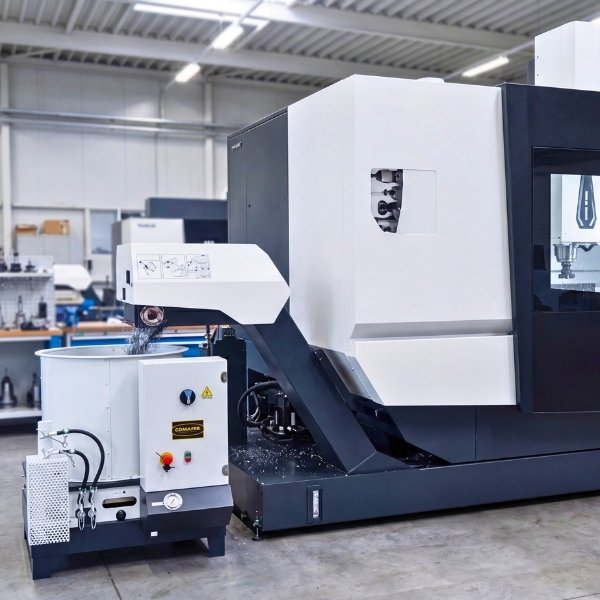
Stand-Alone Installation
Dedicated solution for single machine tools equipped with low-height conveyors and high chip production.

Centralized Installation
Centralized solution for metal chip management and effective emulsion recovery, ideal for compact and multi-machine workshops.
COMAFER After-Sales Service
The value of our after-sales assistance service is ensured by highly qualified technicians and a vast spare parts warehouse capable of guaranteeing assistance even for machines out of production for many years.
We offer scheduled maintenance contracts to prevent the occurrence of problems and malfunctions, minimizing the time and costs associated with any breakdowns and achieving maximum operational efficiency over time.
FAQ
FAQ: Briquette Machines and Grinders
What is an industrial briquetting machine and how does it work?
A briquetting machine is a hydraulic machine that compacts industrial chips and dust into high-density cylindrical briquettes. The cycle is fully automatic and PLC-controlled: the material is measured by a dosing drawer, compressed at pressures up to 3,764 kg/cm2, and then ejected as a cylindrical briquette.
Which materials can be briquetted with COMAFER machines?
COMAFER handles over 60 types of materials divided into 7 categories: wood, metals, textiles, biomass (straw, pomace, rice husk…), plastic, paper/cardboard, and special materials (MDF, leather, feathers). For materials not listed, it is possible to send a sample to the Research and Development department for a free briquetting test.
How much does a COMAFER briquetting machine cost?
The cost varies based on the model, production capacity, and included accessories. Solutions for small businesses (Dinamic 70S, Metalpress 100 EVO) require a lower investment compared to centralized automated systems. Request a personalized quote for an accurate ROI assessment.
What concrete economic advantages does a briquetting machine offer compared to traditional disposal?
The advantages are documented and measurable: a 90% reduction in waste volume, a 70-80% reduction in recycling and handling costs, up to 90% recovery of coolant (Metalpress Series), an increase in the commercial value of the material by up to 50% compared to loose chips, and the production of alternative fuel for autonomous company heating.
How do I choose the right briquetting machine model for my company?
The choice depends on three main factors: the type of material to be briquetted (determines the series: Dinamic, Special, or Metalpress), the hourly quantity of waste produced (determines the specific model in the series), and the desired degree of automation. The COMAFER team offers free consultation and, for specific materials, the possibility of conducting briquetting tests at the internal R&D department.
How often does a COMAFER briquetting machine require maintenance?
COMAFER briquetting machines are designed for a service life above the market average, thanks to mechanical, hydraulic, and electrical components selected from the best available. COMAFER offers scheduled maintenance contracts to prevent breakdowns and reduce machine downtime. The spare parts warehouse guarantees assistance even for machines out of production for many years.
Do I always need to use a grinder before briquetting?
Not always. For wood chips and sawdust that are already of a size suitable for briquetting (typically those resulting from woodworking operations), a grinder is not necessary. However, it becomes essential for bulky waste such as pallets, cardboard boxes, panels, or materials with irregular shapes that cannot be compacted directly.
Is the ground material produced directly suitable for briquetting?
Yes. The grinder is equipped with a perforated screen that determines the particle size of the ground material as it exits, ready to be briquetted. The result is a uniform ground material that can be mixed with wood chips and briquetted.
Can the grinder be connected directly to the briquetting machine?
Yes. Through the intake port, the ground material can be conveyed directly to the briquetting machine via a vacuum system.
Ready to transform your waste chips into value?
Contact us for a free consultation. We analyze your production and waste material to propose the most suitable solution, from a single machine to a turnkey system.