






Dinamic Series
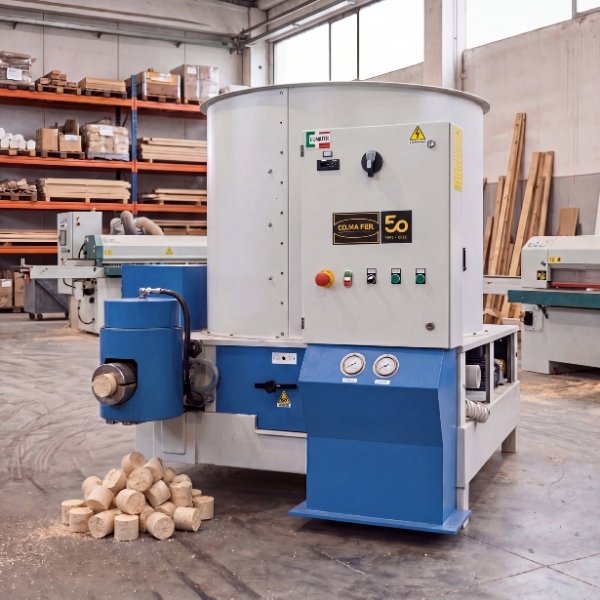
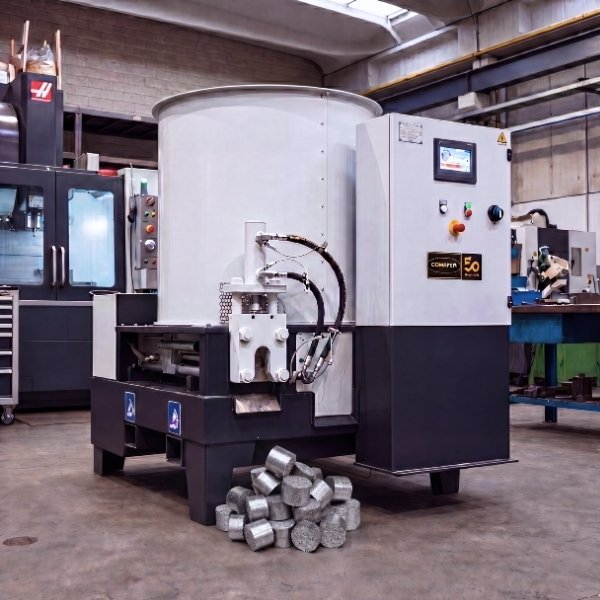
Hydraulic briquetting presses for wood chips and sawdust, paper, biomass, plastic, and other materials
3 Models for Businesses of All Sizes. Production capacity ranging from 30 to 270 kg/h
Turn your wood shavings into high-density cylindrical briquettes. Save space, reduce costs, and add value to your waste.
How Dinamic Series Briquetting Machines Work
The operation of the Dinamic Series briquetting machines is based on a high-pressure mechanical and hydraulic cycle: a paddle agitator, driven by a hydraulic compaction cylinder and assisted by a non-return system, keeps the material constantly present in the accumulation zone, where a hydraulic sliding drawer meters and feeds it into a compaction chamber while the compaction cylinder compresses it to form a cylindrical briquette. A hydraulic clamp, attached to a sleeve, holds the briquette during the compaction phase and controls its movement and ejection.
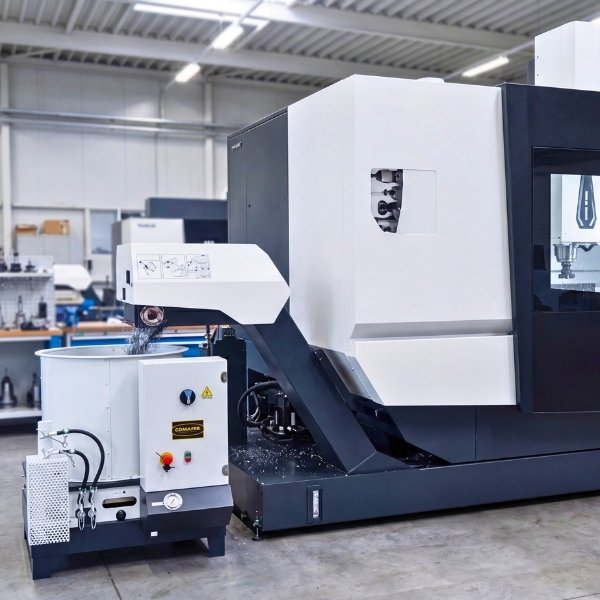
The Dinamic Series is designed to integrate into an automated system with a COMAFER bagging machine or other feeding systems, silos, and filter banks, either inside or outside production facilities.
From hopper to briquette
How the Dinamic series briquetting machines transform wood chips and waste dust into a resource in 4 steps.
01
Feeding
A hopper with agitator ensures a constant flow of material to the fixed chamber.
Dosing
A drawer operated by hydraulic cylinder doses the material into the compaction chamber.
03
Compaction
A compacting hydraulic cylinder compresses the material to form a cylindrical briquette
04
Ejection
A vise with a spindle controls the feeding and ejection of the briquette
Advantages of briquetting with the Dinamic Series

–90% volume
Optimized spaces with increased efficiency, therefore less volume, more order and higher productivity

–70% recycling costs
Briquettes from natural materials allow autonomous heating and direct commercialization

–70% environmental pollution
Better combustion in boilers, optimization of post-combustion residues

–80% handling and transport costs
Drastic reduction of bin emptying operations with consequent forklift movement, reduced operator time with increased safety and greater resource efficiency

+80% combustion yield
Exceptional thermal capacity: average yield of wood briquette 4,000–4,500 kcal/kg vs 2,000–2,300 kcal/kg of firewood

Environmental respect
Fewer containers, fewer trips to collection centers, minimized environmental impact. Lower CO2 emissions, circular economy and ISO 9001:2015 certified green choice
–90% volume
Optimized spaces with increased efficiency, therefore less volume, more order and higher productivity
–70% recycling costs
Briquettes from natural materials allow autonomous heating and direct commercialization
–70% environmental pollution
Better combustion in boilers, optimization of post-combustion residues
–80% handling and transport costs
Drastic reduction of bin emptying operations with consequent forklift movement, reduced operator time with increased safety and greater resource efficiency
+80% combustion yield
Exceptional thermal capacity: average yield of wood briquette 4,000–4,500 kcal/kg vs 2,000–2,300 kcal/kg of firewood
Environmental respect
Fewer containers, fewer trips to collection centers, minimized environmental impact. Lower CO2 emissions, circular economy and ISO 9001:2015 certified green choice
Dinamic series models

Dinamic 70S
Application
Small businesses
Estimated production
30-75 kg/h
Briquette dimensions
55mm

Dinamic 110S
Application
SMEs
Estimated production
50-110 kg/h
Briquette dimensions
60mm
Plus
Oil cooling system

Dinamic PRO M5
Application
Large enterprises
Estimated production
70-270 kg/h
Briquette dimensions
70mm
Plus
Oil cooling system
Siemens HMI
Compatible materials
Which materials can you briquette with the Dinamic Series?
Dinamic Series briquetting machines are designed to compact chips and powders from a wide variety of waste materials. The optimal moisture content for transformation into briquettes must be between 8% and 17%.
Can’t find your material? Send us a test sample: our in-house laboratory tests any material before purchase.

FAQ
Dinamic Series FAQ
What is the main difference between Dinamic 70S and 110S?
The Dinamic 70S is designed for small businesses with production of 30–75 kg/h and produces Ø 55 mm briquettes. The Dinamic 110S is suitable for small-to-medium enterprises with capacity up to 110 kg/h and Ø 60 mm briquettes. Both feature PLC and high-efficiency hydraulic system, but the 110S also has integrated oil cooling.
Can I briquette different types of wood with the same model?
Yes. The Dinamic Series is designed to process all major wood species (hardwood, softwood, MDF, bark) without requiring reconfiguration. Versatility is one of the series’ strengths.
Does material moisture affect briquette quality?
Yes, it is an important parameter. To obtain optimal quality briquettes, material moisture must be between 8% and 17%. Materials that are too wet or too dry can compromise briquette compaction quality. If in doubt, our R&D laboratory can test your material.
Which extraction systems are compatible with the Dinamic Series?
All Dinamic Series models can be connected to silos or filter units, in both internal and external configurations to the production facility.
How long does a COMAFER briquetting machine last?
The operational life of COMAFER machines is designed to be above market average thanks to mechanical, hydraulic, electrical and electronic components selected from the best available suppliers. Each machine undergoes more than 130 specific checks during testing.
Why Choose COMAFER
50 years of experience in industrial briquetting machines and grinders
- Founded in 1975 in Brescia — 50 years of continuous production
- Over 30,000 machines sold in more than 70 countries, 20,000+ satisfied customers
- UNI EN ISO 9001:2015 certification since 1999
- Made in Italy — 1,800 m2 facility in Collebeato (Brescia)
- Premium components: mechanical, hydraulic, electrical and electronic systems among the best on the market
- More than 130 specific checks during testing for each machine
- After-sales service with qualified technicians, structured spare parts warehouse, even for discontinued machines
- Scheduled maintenance contracts
- Custom solutions
- Member of ACIMALL, AMAFOND, CONFAPI
Find the right solution for your company
Tell us about your production requirements: volume of waste chips, type of material, and frequency of use. Our sales representatives will recommend the most suitable model or installation and the best quality-to-price ratio.
Fir
Rosewood
Elm
Acacia
Oak
Teak
Chestnut
Cork
Willow
Pine
Ebony
Birch
Bark
Iroko
Ash
Prunings
Oak
Beech
Mahogany
Walnut
Vine
Cherry
Maple
Douglas
Poplar
Linden
Ground paper
Ground tissue paper
Coffee pod filter waste
Cigarette filters
Banknotes/holograms
Polyethylene
Polyester
Polystyrene
PMMA cigarette filters
Expanded polystyrene EPS
EPS
PET
Polypropylene
Polyurethane
Nylon fibers
Plastic pods
Coffee / bean roasting film
Coconut fiber
Spelt chaff
Millet chaff
Exhausted pomace
Tobacco
Biscuit waste powder
Hay
Feed
Exhausted posidonia
Alfalfa
Forage
Shells
Straw
Rice husk
Chestnut peels
MDF
Dry leather shavings
Insulating panel
Ground cables (nylon-fabric-plastic)
PVC-nylon-PE-teflon-rubber mix
Leather and rubber
Button powder
Leather/hide
Feathers